
 English
 Chinese
 Pусский
Release Paper

You’ve formulated the perfect adhesive, composite, or label stock. But when you peel it from the release paper, the liner either sticks too hard (tearing the adhesive) or releases too easily (losing protection during die‑cutting). The core answer: choosing between silicone‑based and non‑silicone release paper depends on three quantifiable factors – required release force (g/50mm), processing temperature, and final application compatibility. This guide compares both technologies side‑by‑side, provides a 5‑step selection framework, and explains how each coating type affects your converting efficiency and product reliability.
Release force – the amount of force needed to separate an adhesive‑coated face material from the release liner, measured in grams per 50mm width (g/50mm) per FINAT Test Method FTM 10. Silicone release liners typically achieve very low release forces (5‑30 g/50mm), while non‑silicone liners (e.g., wax‑based, fluorosilicone‑free) often give moderate forces (30‑150 g/50mm). Business impact: Too low release force causes adhesive bleed or liner fall‑off during die‑cutting; too high force leads to liner tear and waste.
Silicone release coatings (platinum or peroxide‑cured) can withstand short‑term peaks up to 200°C, making them suitable for high‑temperature lamination or hot‑melt adhesive coating. Non‑silicone coatings (e.g., polyethylene‑based or CCK) typically degrade above 80‑120°C. Business impact: If your process includes heat‑sealing or oven curing, silicone release paper is mandatory; otherwise you risk coating transfer and contamination.
Explore release liner solutions for high‑temperature composites →
The table below quantifies typical technical ranges based on industry practices (FINAT, ASTM D6123).
| Comparison Dimension | Silicone Release Paper | Non‑Silicone Release Paper (e.g., Clay‑Coated Kraft, PE) | Application Guidance |
|---|---|---|---|
| Typical release force range (g/50mm) | 5 – 25 (light) / 25 – 60 (medium) / 60 – 120 (tight) | 30 – 80 (modified wax) / 80 – 150 (CCK/PE) | High‑speed dispensing needs low release force; manual label application needs moderate force. |
| Maximum continuous temperature resistance | 180°C – 200°C (platinum‑cured silicone) | 80°C – 120°C (PE or clay coating) | Business value: For hot‑melt adhesive coating (150°C+), silicone paper is mandatory to prevent coating transfer. |
| Silicone transfer risk | Low if properly cured; but can migrate to adhesive | None (silicone‑free) | For silicone‑based adhesives, non‑silicone liners are required – otherwise adhesive may not cure. |
| Surface energy (dyne/cm) | ~22 – 24 (low, very non‑stick) | ~36 – 42 (moderate, easier to print/cut) | Low surface energy increases dust attraction; CCK offers better static dissipation. |
| Typical basis weight range (g/m²) | 40 – 160 (glassine, kraft, SCK) | 60 – 200 (CCK, PE‑coated kraft) | Heavier non‑silicone paper gives better dimensional stability for large die‑cut labels. |
Quantified insight: Switching from a light‑release silicone liner (10 g/50mm) to a medium‑release non‑silicone liner (70 g/50mm) increases the peel force by 7×. That means your high‑speed label dispenser may stall or pull the liner – potentially reducing line speed by 20‑30%. Always validate with your converting equipment.
External reference (real): According to FINAT (International association for self‑adhesive label industry) Technical Handbook 2021, the recommended release force for automatic label dispensing is 15‑50 g/50mm for most pressure‑sensitive adhesives. Values above 80 g/50mm require specialized high‑torque peel systems.
ISO 9001:2015 requires documented control of release liner consistency. Many converters qualify release paper via ASTM D6123 – Standard Specification for Pressure‑Sensitive Tape Used for Electrical Insulation, which includes release force measurement. For food contact applications, EU Regulation No 10/2011 on plastic materials restricts certain silicone additives. Business impact: If your release paper is not certified for your target market (e.g., EU food contact), you may face import rejection.
View our engineered release film series for cleanroom applications →
A manufacturer makes double‑sided tape for automotive foams. The hot‑melt adhesive is applied at 160°C onto the release liner. Using non‑silicone CCK paper caused coating penetration and liner scorching. Solution: Platinum‑cured glassine silicone release paper (basis weight 90 g/m², release force 25 g/50mm). Top 3 criteria: thermal stability > smoothness > release force consistency.
The adhesive itself contains silicone gel. Any silicone release liner would cause “cure inhibition” – the gel never fully crosslinks. Solution: A non‑silicone fluoropolymer‑coated release paper (specialty grade) or a PE‑coated kraft with release agent free of silicone. Top 3 criteria: silicone‑free certification > peel force < 30 g/50mm > biocompatibility (ISO 10993).
No high heat, no silicone adhesive. The converter uses a rotary die‑cutter at 80 m/min. Non‑silicone CCK release paper gives moderate release force (80 g/50mm) but causes occasional liner breaks. Switching to a light‑silicone glassine (15 g/50mm) eliminated breaks and increased line speed to 110 m/min. Top 3 criteria: release force <30 > dimensional stability > die‑cutting cleanliness.
For similar industry‑specific needs, refer to our market application guides →
Q1: Can I use silicone release paper with silicone adhesives? Generally no. Silicone adhesives require a non‑silicone release liner (e.g., fluoropolymer‑coated or PE‑coated). The residual silicone on the liner can migrate into the adhesive and prevent full crosslinking, resulting in a tacky, uncured surface.
Q2: What is the typical shelf life of silicone vs. non‑silicone release paper? Both have 12‑24 months when stored at 23±2°C and 50±5% RH away from UV light. Silicone release papers can lose release performance over time if the cure is incomplete (oxidation). Non‑silicone liners are more stable but may absorb moisture, causing curl.
Q3: How do I test whether a release paper is truly silicone‑free? The most reliable method is FTIR (Fourier‑Transform Infrared Spectroscopy) or XPS (X‑ray Photoelectron Spectroscopy) to detect Si‑O‑Si bonds. For quick field testing, apply a drop of dyne solution with a surface tension of 34 mN/m – if it beads up, silicone may be present. However, only lab analysis gives definitive proof.
Q4: Which release paper works best for medical dressing manufacturing? Medical applications often require non‑silicone release liners (silicone‑free) to avoid interfering with wound healing adhesives. Polyethylene‑coated kraft (PE release paper) or fluorosilicone‑free glassine are common choices. They must meet ISO 10993‑10 for skin irritation and ISO 11607 for sterile barrier systems.
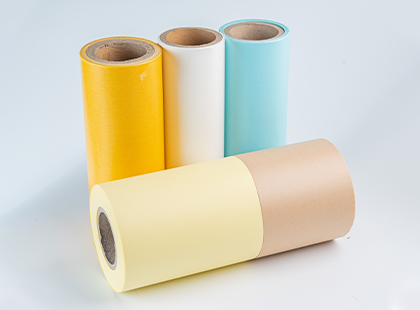
Q5: Does the color of release paper affect performance? No. White, yellow, blue, or kraft‑brown colors come from dyes or natural pulp and do not change release force or thermal resistance. However, colored liners help with visual identification on high‑speed lines. Ensure the dye does not migrate – request a migration test if color is used.
Q6: How can I reduce static buildup during release liner unwinding? Non‑silicone liners like CCK (clay‑coated kraft) have higher surface conductivity and generate less static than pure silicone glassine. For extreme anti‑static needs, request an **anti‑static treatment** (coating with conductive polymer) – available on both silicone and non‑silicone grades from many suppliers.
Selecting between silicone and non‑silicone release paper is not about “better” – it’s about matching three measurable parameters: adhesive chemistry, processing temperature, and release force window. Start by determining your adhesive’s compatibility (silicone‑based? → non‑silicone liner). Then measure your max process temperature (over 130°C? → silicone paper). Finally, validate release force with your converting equipment. A wrong choice can increase waste by 5‑10% or cause product recalls.
Next action: Request sample liners in both technologies and run a peel test on your actual adhesive. For technical specification sheets and standard dimension series, refer to our detailed product overviews.
Internal link 3: Read our guide on non‑silicone release films for electronics lamination →
This article is for informational and educational purposes. All technical discussions and decision frameworks are provided to help you make informed purchasing decisions. No direct sales or pricing information is included. — SanLin New Materials

Unleash creativity, perfect release - choose SANLIN, specializing in the manufacture of release film and paper.