
 English
 Chinese
 Pусский
Release Paper

When a pressure-sensitive adhesive product fails weeks after passing quality control, the culprit is often not the adhesive chemistry but the release liner sitting behind it. Coating blocking, release force drift, and silicone contamination can emerge long after production—and your choice between release paper and release film is usually the starting point where these issues begin.
For converters, adhesive formulators, and industrial engineers, the decision between paper-based and film-based release liners involves a complex set of trade-offs. No liner type is universally superior; each has distinct strengths and limitations depending on the application's thermal demands, precision requirements, storage conditions, and cost constraints. A 2023 benchmark study by the National Institute of Standards and Technology (NIST) found that inconsistent material handling accounts for up to 30% of integration delays in automated converting lines, underscoring the importance of selecting the right release liner from the outset. This guide provides a technical framework for evaluating these two liner categories, translating material science into practical decisions that directly impact your production yield and end-product reliability.
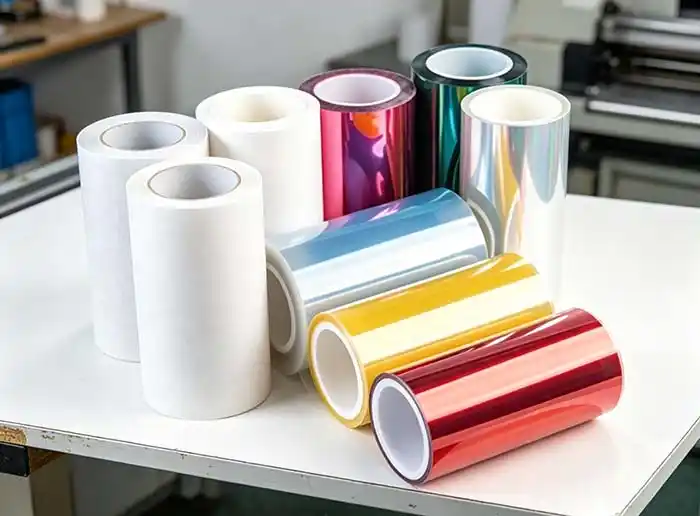
At the fundamental level, a release liner is a paper- or plastic-based backing designed to prevent adhesive from sticking prematurely while protecting it during converting, storage, and transport. Both release paper and release film serve this function, but their substrate materials produce fundamentally different mechanical and chemical behaviors.
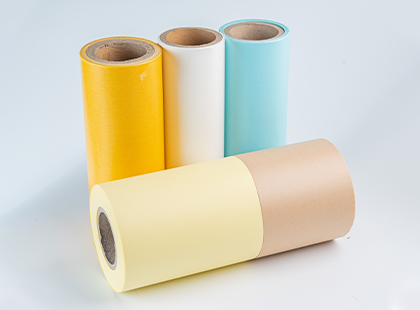
Release paper is an anti-stick paper, also known as silicone paper, designed to prevent adhesion of prepreg materials while protecting them from contamination. Its fibrous structure allows silicone release agents to anchor into the fiber matrix, creating stable release performance but introducing the risk of moisture-related dimensional changes.
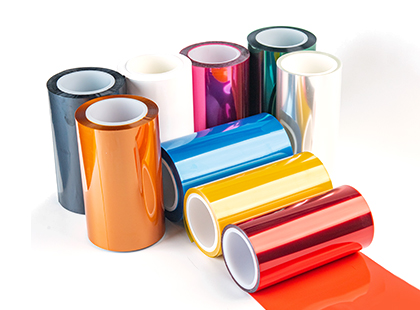
Release film involves coating a silicone release agent onto the surface of eco-friendly materials such as PET, PE, or OPP films, providing an extremely light and stable release force for various pressure-sensitive adhesives. Film liners offer consistent thickness and stable behavior during application because they are not affected by humidity like paper, making them perform well in high-speed and high-precision operations.
The global release liner market provides important context for these material choices. According to the AWA Release Liner Market Report 2026, the global release liner market grew by 2% in 2025, with pressure-sensitive labelstock continuing as the largest segment, holding a 48% share worldwide. AWA forecasts a growth of 2.7% going into 2026 as demand and supply balances stabilize. Meanwhile, the global release film market was valued at USD 1.52 billion in 2024 and is projected to grow at a CAGR of 7.4% to reach USD 2.89 billion by 2032, driven by expanding composite material applications and demand from the pharmaceutical packaging sector. This faster growth rate for film liners reflects increasing demand for high-precision applications.
For converters seeking high-precision release solutions, exploring paper and film liner performance specifications side by side is a logical next step. You can review Sanlin’s Release Paper and Release Film series to compare baseline characteristics.
The table below summarizes the critical engineering differences between release paper and release film. Understanding these distinctions helps converters predict how each liner type will behave in specific production and storage environments.
| Characteristic | Release Film | Release Paper |
|---|---|---|
| Base substrate | PET, LDPE, PP | SCK, Glassine, CCK, Kraft |
| Surface porosity | Non-porous | Micro-porous |
| Silicone bonding | Weak/moderate | Stron |
| Humidity reaction | Minimal | Absorbs and expands |
| Dimensional stability | Excellent | Moderate to low |
| Thermal resistance | High | Moderate |
| Release force drift risk | High | Medium |
| Silicone migration risk | Common | Rare |
| Blocking tendency | High if unoptimized | Lower |
| Die-cutting performance | Consistent, clean edges | Varies by grade |
| Relative cost | Higher | Lower to moderate |
Sources: Compiled from industry technical data.
This table reveals the fundamental trade-off: release film delivers superior dimensional precision and thermal stability, but requires careful management of release force drift and silicone migration. Release paper offers more stable long-term release characteristics due to silicone anchoring, but humidity control becomes critical to prevent dimensional issues.
PET liners are the most stable option among film liners—they stretch very little and keep their shape even at high speeds, helping labels release smoothly and land in the correct position. For automated lines requiring precision placement, this stability is invaluable. However, this comes with higher material costs and the need to address potential silicone migration.
SCK release paper is often considered a balanced option between CCK and glassine paper, offering more uniform silicone coating performance and better die-cutting stability while maintaining good strength and stiffness. Glassine release paper, produced through intensive supercalendering, delivers excellent die-cutting performance and clean edges—ideal for high-precision electronics and medical labels. CCK release paper is more cost-competitive and offers good dimensional stability, suitable for large-scale industrial production where die-cutting precision requirements are moderate.
One of the most underestimated risks in release liner selection is release force drift: the gradual change in peel-off force between a liner and coated surface over time. It may rise or fall. Neither outcome is acceptable for converters shipping finished products.
Release films are especially vulnerable to release force drift because silicone coatings sit on top of smooth plastic surfaces rather than anchoring into a fibrous matrix. Poor bonding means silicone can migrate or transfer under pressure or heat, resulting in tacky surfaces, gloss loss, and full-surface blocking. Films can also shrink microscopically during temperature cycling, increasing pressure on coated surfaces.
Release paper allows silicone to anchor into the fiber matrix, providing longer-term stability. However, the fibrous structure introduces the risk of moisture-related dimensional change—paper can swell when absorbing humidity, affecting flatness and unwind performance.
A controlled accelerated aging study compared PET release film and glassine release paper under simulated warehousing conditions:
| Parameter | Release Film | Release Paper |
|---|---|---|
| Initial release force | 18 g/in | 22 g/in |
| Aged release force | 58 g/in | 34 g/in |
| Blocking tendency | Severe | Mild |
| Surface gloss drop | 35% | 12% |
| Silicone residue on coating | High | Trace |
The results are telling: release film caused significant release force drift, silicone contamination, and full-surface blocking. Paper swelled slightly but showed no chemical transfer. For converters producing precision adhesive products, these aging behaviors have direct financial implications—rework, scrap, and customer returns all increase when product performance changes after shipment.
Practical implication for converters: If your production includes long warehousing periods or shipments to humid climates, release paper offers more predictable aging characteristics. If you need optical clarity or high-temperature process compatibility and can implement plasma or corona treatment to improve silicone bonding on film, release film may still be viable—but you must test drift under roll pressure for at least 30 days before committing to production.
Understanding liner behavior under real-world conditions is essential for composite part quality and process stability. For converters supplying into demanding sectors like aerospace and wind energy, production environments place stringent demands on release materials—explore how the right liner selection supports different converting applications across your product portfolio.
For converters, release liners are not passive materials—they directly interact with processing equipment, affecting everything from die-cutting efficiency to label dispensing reliability. The choice between paper and film impacts these operational parameters in distinct ways.
Die-cutting performance: For label converters, the substrate/release liner combination needs to provide a reliable surface so the die-cut strike-through cuts the label completely, yet does not cut or weaken the liner below. Glassine release paper excels here due to its high density and transparency, which provide excellent die-cutting stability and waste stripping. SCK release paper offers more uniform coating performance and die-cutting stability than standard kraft or CCK. PET film liners offer consistent thickness uniformity, making them ideal for high-precision applications like membrane switches and flexible circuits.
High-speed dispensing: Film liners perform exceptionally well in high-speed and high-precision labeling operations. Because they are not affected by humidity like paper, they reduce breaks and misalignment during dispensing. PET liners stretch very little and keep their shape even at high speeds, which helps labels release smoothly and land in the correct position. However, paper liners remain the most used option due to their stiffness, availability, and cost-effectiveness for many applications.
Liner stiffness and flatness: CCK paper has the lowest density and opacity among paper liners, lying flat due to its low flexibility—properties that make it suitable for graphics or laser labels. Glassine offers higher density and lower opacity, with excellent strength and stiffness, making it suitable for high-speed automated labeling. Film liners, particularly PET, offer exceptional stiffness and flatness but at a higher cost point.
Temperature considerations: The global composites market is projected to reach USD 125.61 billion in 2026 at a CAGR of 9.7%, driven by aerospace, automotive, and wind energy applications. Within renewable energy specifically, the composite materials market is valued at USD 7.87 billion in 2025 with a CAGR of 10.38%, reaching USD 15.72 billion by 2032. As these demanding industries grow, converters serving these sectors must consider their thermal process requirements carefully.
Film substrates vary in heat tolerance—PET film can withstand continuous temperatures up to 200°C, making it suitable for high-temperature composite curing processes, while PP is limited to approximately 120°C and PI (polyimide) can handle 300°C+ for extreme aerospace applications. Paper liners generally have lower thermal resistance—glassine paper performs up to approximately 150°C, while some CCK grades offer higher thermal stability due to their clay coating.
Converting applications vary widely in their requirements. Below are two illustrative scenarios to help converters match liner type to operational demands.
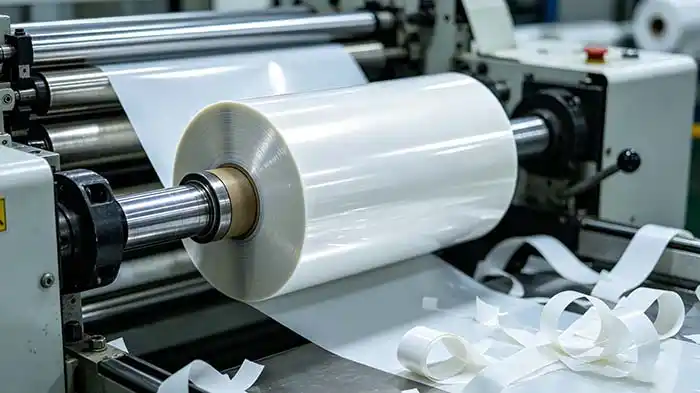
Key demands: Consistent die-cutting, clean waste stripping, reliable high-speed dispensing, cost efficiency at scale
Recommended approach: Paper release liner
Why: Glassine offers excellent die-cutting performance with clean edges and smooth waste removal, particularly for electronic and medical labels where dimensional accuracy is critical. SCK provides a balanced option for thermal transfer label printing and applications requiring reliable die-cutting without premium glassine costs. Paper liners remain the most used option due to their stiffness, availability, and cost-effectiveness.
High-speed note: For ultra-high-speed automated lines where humidity-induced paper expansion could cause jams, film liners (PET) may be preferred for their dimensional stability—but at higher material cost and requiring plasma/corona treatment to manage silicone migration.
Key demands: Ultra-precise dimensions, anti-static properties, high-purity cleanliness, complex die-cut geometries
Recommended approach: Film release liner
Why: PET offers better thickness uniformity and tensile strength, which are vital for membrane switches, flexible circuits, and other high-precision electronics. PET liners stretch very little and keep their shape even at high speeds, ensuring labels land in the correct position. Anti-static grades can prevent static electricity from damaging sensitive electronic devices during processing.
Complex die-cutting: Glassine release paper also performs well here due to its high density, semi-transparent appearance, and excellent die-cutting stability, offering a cost-effective alternative when anti-static requirements are not critical.
Key demands: Thermal stability for epoxy curing, chemical resistance, no silicone contamination
Recommended approach: Film release liner for high-temperature processes; SCK/CCK paper for moderate-temperature applications with tight release stability requirements
Why: PET films are rated for continuous use up to 200°C and are compatible with autoclave and thermal curing processes. PET provides high tensile strength, thermal stability, and low shrinkage. Platinum-cured silicone offers stability up to 220°C. For processes where high temperatures are not required and release stability is the priority, paper liners provide more predictable long-term performance with lower silicone migration risk.
Emerging markets: The global advanced composites market was valued at USD 100 billion in 2025 and is projected to reach USD 185 billion by 2034, growing at 7.6% CAGR. As wind turbine rotor diameters grow and composite applications expand into precision components, converters supporting these high-value industries require release solutions that deliver both high-temperature tolerance and contamination control. Release films meeting these specifications are well-positioned for this demand.
For converters entering these high-value markets, understanding composite manufacturing requirements is essential. Our solutions page provides application-specific guidance for release materials in composites, electronics, automotive, and other demanding sectors.
Use the following five-question framework to guide your release liner selection:
Below 150°C → Paper or Film is viable
150°C–200°C → PET film required
Above 200°C → PI film or specialized high-temperature paper
Moderate → Paper suitable
High → PET film or Glassine paper
Extreme precision → PET film with anti-static treatment
Short storage / low humidity → Both paper and film are acceptable
Long storage / high humidity / variable climate → Paper offers more stable release; implement humidity control in the warehouse
Any climate without warehouse control → Test drift under simulated conditions
High-aggressive acrylics → Heavy release required; paper offers better long-term stability
Light-release medical applications → Low-release paper or carefully specified film
UV-curable or specialty coatings → Test for silicone migration risk; paper generally safer
Balanced performance-cost → SCK paper
Once you have clarified these key decision factors, comparing the specific specifications of available options becomes the next logical step. You can review Sanlin’s release liner series for different converting scenarios—Release Paper series for applications where stable long-term release and cost efficiency are priorities, or the Release Film series for high-precision, high-temperature, or anti-static requirements.
For converters facing unique production challenges, working with a manufacturer that understands the interplay between substrate, silicone chemistry, and converting processes is essential. With over 15 years of industry experience and annual production capacity of 15,000 tons, Sanlin provides customized release solutions tailored to specific application requirements across composites, electronics, automotive, medical, packaging, construction, and advertising labels.
How Humidity and Temperature Affect Release Liner Performance in Storage and Shipping
Silicone Anchor Technology: Why It Matters for Your Die-Cutting Operation
Glassine vs SCK vs CCK: Selecting the Right Paper Release Liner for Your Application
Silicone vs Non‑Silicone Release Paper: Which One Fits Your Process?
Composite Manufacturing: Release Liner Selection for Epoxy Curing Processes
This article is part of Sanlin New Materials’ technical content library. No direct sales or pricing information is included. All technical discussions aim to help converters make informed purchasing decisions.

Unleash creativity, perfect release - choose SANLIN, specializing in the manufacture of release film and paper.